(EGPT051) Ancient Egyptian Hieroglyphs – Advanced
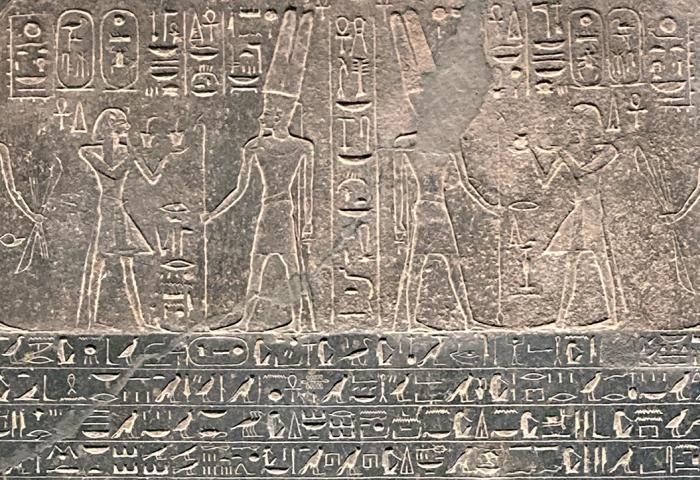
Ancient Egyptian Heiroglyphs

Image: © Dr Bill Manley

Overview

Course start date: Monday 20th April 2026
Course end date: Friday 26th June 2026

Price: £150 BOOK NOW

Tutor: Dr Bill Manley
Course Code: EGPT051
Level: Non-accredited, non-credit bearing
Assessments/Exams: None. Throughout the course you will be given ideas and questions to respond to in the online discussion area. Participation in online discussion is encouraged, but not compulsory.
Duration: 10 weeks
Estimated Student Study Time: 2 – 5 hours per week are recommended, but time spent is flexible and at your discretion.
Price: £150.00
Pre-Requisites: You should have already completed the Learn For Pleasure course EGPT050 (Ancient Egyptian Hieroglyphs – Intermediate) or have equivalent reading ability in the Middle Egyptian language in hieroglyphic writing.
Delivery: Online Distance Learning
Late Entrants: If this course is not full by the start date then late entrants will be accepted for up to two weeks after the start of the course. As a late entrant you can choose to catch up on the material you have missed or you can skip the missed weeks and concentrate on the material at the point where you join the course, but unfortunately we cannot offer fee reductions or course extensions for late entrants.
Required Reading**: The following book is the set text for this course and you will need to acquire it prior to the course start.

How To Read Egyptian Hieroglyphs
M.A. Collier and W.P. Manley
  
British Museum Press, (1998/2003/2022)

Note that this is the same book that was required for the courses EGPT009 (Ancient Egyptian Hieroglyphs for Beginners) and EGPT050 (Ancient Egyptian Hieroglyphs – Intermediate). Any edition is suitable.

If you buy books using this link, we may earn a commission from Bookshop.org, whose fees support independent bookshops, and which helps us keep our course costs low.

**Please note: All courses are subject to sufficient numbers of students registering before they are confirmed as running. Therefore, after booking your place you are advised not to purchase any texts until you have received confirmation that the course is running. Remember, however, that the required text is the same book that was required for the courses EGPT009 (Ancient Egyptian Hieroglyphs for Beginners) and EGPT050 (Ancient Egyptian Hieroglyphs – Intermediate).

Summary

You may be approaching the subject due to a general interest in Egyptology, or you may be someone with a broader interest in languages, linguistics, history, Coptic, art history, religion or philosophy. Anyone wishing to study this subject is welcome, whatever the reason for your interest. However, the course assumes you already have an experienced reading knowledge of Ancient Egyptian hieroglyphic inscriptions. Specifically, the course is intended for those who have already completed the course EGPT050 (Ancient Egyptian Hieroglyphs – Intermediate).

Through a series of short video tutorials and follow-up practical exercises with tutor support, this course will help you progress to a more sophisticated level of reading by concentrating on texts about the pharaohs, including an inscription of king Thutmose III (c. 1479–1425 BC) and a hymn of praise for king Senwosret III (c. 1840–1805 BC), along with extracts from a tale about an early king. These texts not only exemplify new aspects of the language for you to learn and understand, they are also first-class sources of historical and cultural information.

Syllabus Plan

Week 01. Revisiting some crucial topics
Week 02. Indicative and prospective statements
Week 03. A new word order
Week 04. The stative and verbs of motion
Week 05. Indicative and engaged statements
Week 06. Participles and relative forms once more
Week 07. Questions and second tenses
Week 08. Passive and positive
Week 09. Some negative thinking
Week 10. All things considered

Course Content in Depth

Week One. Revisiting some crucial topics

Let’s begin our course by revising and expanding our knowledge of two crucial topics: (1) the different classes of verbs, and (2) how statements may be expanded or qualified. We also look at statements based on adjectives rather than verbs.

Week Two. Indicative and prospective statements

We discuss similarities and differences between statements about (indicative) what happened in the past or typically happens in the present, and (prospective) those looking to the future. We also discuss some similarities and differences between particles and auxiliaries, used to introduce or qualify statements.

Week Three. A new word order

Now we need to look at engaged statements – those that talk about what someone is doing right now or is bound to do in the future. These also include different kinds of statements about where someone is situated at the moment.

Week Four. The stative and verbs of motion

This time we talk about the unexpected behaviour of verbs of motion and verbs related to emotions and mental states. This leads us to discuss a new Egyptian verb form, known as the stative.

Week Five. Indicative and engaged statements

We need to take a moment to summarise some similarities and differences between statements about what is typically true (indicative) and about what is actually happening (engaged).

Week Six.  Participles and relative forms once more

Let’s spend a moment revising and expanding our understanding of statements that characterise people in a certain way, or identify a person within a group, by taking another look at how verbs are used as participles or relative forms.

Week Seven. The second tenses

This week we get to know the second present tense and second past tense, and discuss how and why they are used instead of the ordinary present and past tenses. In particular, we look at how second tenses are used in questions and other statements that require a particular emphasis.

Week Eight. Passive and positive

This week we take a first proper look at those (passive) statements in Middle Egyptian whose subject is not actually doing the action but on the receiving end of the verb, along the lines of ‘the enemy was overwhelmed’ or ‘I got spotted’. We also meet a passive second tense.

Week Nine. Some negative thinking

Time now to analyse how different types of statements in Middle Egyptian are made negative in different but predictable ways, looking specifically at: (a) the negative forms of engaged, indicative and prospective tenses; and (b) the negative forms of second tenses.

Week Ten. All things considered

To end our course, let’s summarise the crucial points you have learned during the course, and apply them in some extended reading.

Learning and Teaching Methods

A unit of course material will be released every week for you to work through. Class discussions on this material will take place in the online discussion forums.

Class discussions are asynchronous – i.e. you do not need to be online at a set time; you can leave and collect messages from the online discussion forums at a time suitable for you.

Learning Outcomes

This course will help you to develop:

  • a more sophisticated knowledge of the Middle Egyptian language and the ability to read longer, more complex hieroglyphic inscriptions
  • the ability to demonstrate this knowledge through your translation skills
  • the ability to recognise and interpret the meaning, use and archaeological context of the monuments studied during the course within the context of ancient Egyptian material culture
  • the ability to discuss new historical, cultural and language topics relevant to the ancient texts studied during the course

(EGPT050) Ancient Egyptian Hieroglyphs – Intermediate

Ancient Egyptian Heiroglyphs

Overview

Course start date: Monday 20th April 2026
Course end date: Friday 26th June 2026

Price: £150 BOOK NOW

Tutor: Dr Bill Manley
Course Code: EGPT050
Level: Non-accredited, non-credit bearing
Assessments/Exams: None. Throughout the course you will be given ideas and questions to respond to in the online discussion area. Participation in online discussion is encouraged, but not compulsory.
Duration: 10 weeks
Estimated Student Study Time: 2 – 5 hours per week are recommended, but time spent is flexible and at your discretion.
Price: £150.00
Pre-Requisites: You should have already completed Learn for Pleasure Course (EGPT009) Ancient Egyptian Hieroglyphs for Beginners or have an equivalent reading ability in the Middle Egyptian language.
Delivery: Online Distance Learning
Late Entrants: If this course is not full by the start date then late entrants will be accepted for up to two weeks after the start of the course. As a late entrant you can choose to catch up on the material you have missed or you can skip the missed weeks and concentrate on the material at the point where you join the course, but unfortunately we cannot offer fee reductions or course extensions for late entrants.
Required Reading**: The following book is the set text for this course and you will need to acquire it prior to the course start. Note that this is the same book that was required for the course (EGPT009) Ancient Egyptian Hieroglyphs for Beginners:

How To Read Egyptian Hieroglyphs
M.A. Collier and W.P. Manley
  
British Museum Press, 2003.

The first edition of this text, published in 1998, is also suitable for the course.

If you buy books using this link, we may earn a commission from Bookshop.org, whose fees support independent bookshops, and which helps us keep our course costs low.

**Please note: All courses are subject to sufficient numbers of students registering before they are confirmed as running. Therefore, after booking your place you are advised not to purchase any texts until you have received confirmation that the course is running. Remember, however, that the required text is the same book that was required for the course (EGPT009) Ancient Egyptian Hieroglyphs for Beginners.

Summary

You may be approaching the subject due to a general interest in Egyptology, but this will not be assumed; for example, you may equally be someone with an interest in languages, linguistics, Coptic, art history, religion or philosophy. Anyone wishing to study this subject is very welcome, whatever the reason for your interest.

However, this course assumes you already have a basic reading knowledge of Ancient Egyptian hieroglyphic inscriptions. Specifically, the course is intended for those who have already completed course (EGPT009) Ancient Egyptian Hieroglyphs for Beginners.

Through a series of short video tutorials and follow-up practical exercises with tutor support, this course will help you progress from the elementary grammar of Middle Egyptian to a more sophisticated level of reading hieroglyphic inscriptions from the Old, Middle and New Kingdoms.

Syllabus Plan

Week 01: Verbs and captions once again
Week 02: The gods speak: I have done something
Week 03: Talking about the past
Week 04: She has not heard … about negation
Week 05: What’s going on (and when?)
Week 06: The word order we find
Week 07: Let’s talk about me and the dedication formula
Week 08: Participles: who does what?
Week 09: The appeal to the living
Week 10: Looking to the future

Course Content in Depth

Week One: Verbs and captions once again

Let’s begin our course by revising two topics: (1) the different classes of verbs; and (2) the use of infinitives in captions. Knowledge of both is going to be fundamental in improving your ability to read Middle Egyptian.

Week Two: The gods speak: I have given you something

We look at the standard formula that introduces the speeches of gods on royal monuments. This will lead us on to discuss the past tense for the first time.

Week Three: Talking about the past

We return to discussing the past tense, paying particular attention to two topics: (1) how auxiliaries help us read sentences; and (2) the uses of pronouns.

Week Four: She has not heard … about negation

We return to discussing how simple past narratives are structured in Middle Egyptian, including: (1) the negative past tense; and (2) how to talk about making someone do something.

Week Five: What’s going on (and when?)

We turn to the present tense and how it interacts with the past tense in narratives. From this, we discuss the crucial topic of aspect in verbs.

Week Six: The word order we find

Time to pull together and summarise some facts we already know about the order of words in Middle Egyptian sentences. We also begin delving into the topic of relative forms (clue, there is one in the title of this class).

Week Seven: Let’s talk about me and the dedication formula

We begin the important topic of characterisation by looking at some words for ‘I am’ and ‘he is’/‘she is’. This will lead us to begin discussing the Egyptian verb forms we call participles. We also look at: (1) the full titularies of kings; and (2) the dedication formula, which specifies who is responsible for commissioning a monument.

Week Eight: Participles: who does what?

Participles are fundamental when going forward in reading, so now is the time to concentrate on their meanings and how they are written. We also remark on the distinction between active and passive participles, in particular the words for ‘beloved’ and ‘praised’.

Week Nine: The appeal to the living

We can talk about the future for the first time in order to discuss the formula known as the appeal to the living. We also talk about a useful group of adjectives that seems similar in English and Middle Egyptian.

Week Ten: Looking to the future

To end our course, we discuss a verb form used to talk about the future in terms of what we may anticipate, expect or even hope for. We also discuss how it is made negative. Finally, we summarise some important points you already know about Middle Egyptian for you to keep in mind in the future.

Learning and Teaching Methods

A unit of course material will be released every week for you to work through. Class discussions on this material will take place in the online discussion forums.

Class discussions are asynchronous – i.e. you do not need to be online at a set time; you can leave and collect messages from the online discussion forums at a time suitable for you.

Learning Outcomes

This course will help you to develop:

  • a more sophisticated knowledge of the Middle Egyptian language and the ability to read longer, more complex hieroglyphic inscriptions
  • the ability to demonstrate this knowledge through your translation skills
  • the ability to recognise and interpret the meaning, use and archaeological context of the monuments studied during the course within the context of ancient Egyptian material culture
  • the ability to discuss new cultural topics and language topics relevant to the monuments studied during the course

2,500 Year Old Egyptian Mummy Found Intact

Saqqara step pyramid

59 astonishingly preserved Egyptian Mummies have been uncovered south of Cairo by archaeologists in the last few weeks. Discovered within their sealed and elaborately decorated wooden coffins, evidence suggests they were buried at Saqqara over 2,500 years ago.

Discovery made in legendary area of Egypt

Famous for the 4,700 year old stepped pyramid of Djoser, which was built during the Third Dynasty, Saqqara is the oldest stone building complex known to have been built in history. It served as the burial ground to the ancient Egyptian capital of Memphis and is now a UNESCO World Heritage Site.

Unveiling one of their finds, the archaeological team uncovered an ancient mummy still wrapped within its burial cloth adorned with brightly coloured ancient Egyptian hieroglyphs.

More ancient finds expected

This follows the discovery of 13 coffins just a few weeks ago, and the team on site are anticipating yet more exciting finds. The current haul were found in shafts up to 40 feet underground, and are believed to date back to the Late Period of Ancient Egypt – around the 6th or 7th century BCE.

The tourism and antiquities minister, Khaled al-Anani, explained that while further investigation will be needed, it is thought that the sarcophagi were the final resting place for important figures of the time, such as priests and senior statesmen of the 26th dynasty.

The area also surrendered a significant number of statues. Amongst them was an impressive bronze figurine of Nefertem, who represented the blue lotus flower present at the creation of the earth. The ancient Egyptians often carried small statuettes of him as good-luck charms.

The finds will be permanently added to the collection of the new Grand Egyptian Museum on the Giza plateau, which is due for its grand opening in 2021.

Learn More

If you’d like to learn more about the Egyptians and their ancient writing system, why not book a place on our next online Hieroglyphs course?

(by Learn for Pleasure on 9th October 2020)


(EGPT009) Ancient Egyptian Hieroglyphs for Beginners

Ancient Egyptian hieroglyphs

Overview

Course start date: Monday 20th April 2026
Course end date: Friday 26th June 2026

Price: £150 BOOK NOW

Tutor: Dr Bill Manley
Course Code: EGPT009
Level: Non-accredited, non-credit bearing
Assessments/Exams: None. Throughout the course you will be given ideas and questions to respond to in the online discussion area. Participation in online discussion is encouraged, but not compulsory.
Duration: 10 weeks
Estimated Student Study Time: 2 – 5 hours per week are recommended, but time spent is flexible and at your discretion.
Price: £150.00
Pre-Requisites: None – no academic qualifications or experience of studying Egyptology or linguistics are required – only an enthusiasm for this subject.
Delivery: Online Distance Learning
Late Entrants: If this course is not full by the start date then late entrants will be accepted for up to two weeks after the start of the course. As a late entrant you can choose to catch up on the material you have missed or you can skip the missed weeks and concentrate on the material at the point where you join the course, but unfortunately we cannot offer fee reductions or course extensions for late entrants.
Required Reading**: The following book is the set text for this course and you will need to acquire it prior to the course start:

How To Read Egyptian Hieroglyphs
M.A. Collier and W.P. Manley
  
British Museum Press, 2003.

The first edition of this text, published in 1998, is also suitable for the course.

If you buy books using this link, we may earn a commission from Bookshop.org, whose fees support independent bookshops, and which helps us keep our course costs low.

**Please note: All courses are subject to sufficient numbers of students registering before they are confirmed as running. Therefore, after booking your place you are advised not to purchase any texts until you have received confirmation that the course is running.

This course was previously taught by Dr Bill Manley when it was offered by the University of Exeter*. If you studied it with the University of Exeter* you might not wish to study it again with Learn for Pleasure as although we have revised and updated our courses where necessary, it will likely be substantively the same.

Summary

You may be approaching the subject due to a general interest in Egyptology, but this will not be assumed; you may equally be someone with, for example, an interest in languages, linguistics, Coptic, art history, religion or philosophy. Anyone wishing to study this subject is very welcome, whatever the reason for your interest.

Intended for complete beginners, but also well suited to those returning to the subject, this course will teach you the basics needed to read the kinds of Ancient Egyptian monuments typically found in museum collections.

Through a series of short video tutorials and follow-up practical exercises with tutor support, this course will help you progress from the basics of hieroglyphic writing to becoming familiar with the commonest signs and the elementary grammar of the Middle Egyptian language.

Syllabus Plan

Week 01: The Language of Ancient Egypt / Hieroglyphs and Ancient Egyptian
Week 02: Sound-Signs and Determinatives
Week 03: Word Order and Short Phrases
Week 04: Unexpected Writings / ‘Revered Ones’
Week 05: The Offering Formula
Week 06: Everything Perfect and Pure On Which A God Lives
Week 07: Seeing the Perfection of Osiris / A Word About Verbs
Week 08: Kingship and Hieroglyphs
Week 09: The Kings and the Gods
Week 10: Labelling and Dating Kings’ Actions

Course Content in Depth

Week One: The Language of Ancient Egypt / Hieroglyphs and Ancient Egyptian

There will be a short presentation about the Egyptian language, and then we will look at how hieroglyphs were used to write the sounds of the Ancient Egyptian language, looking especially at one-sound signs and determinatives.

Week Two: Sound-Signs and Determinatives

We will look at how the Ancient Egyptians used hieroglyphs to write specific combinations of more than one sound, and how these are combined with sound complements to write words.

Week Three: Word Order and Short Phrases

We take a first look at how words are combined to form short phrases, including elements such as number, gender, agreement, and word order.

Week Four: Unexpected Writings / ‘Revered Ones’

We look at different ways of writing the same word and reasons for doing so, such as abbreviation or changes made for space or to signify prestige. There will also be a presentation on various titles, but especially the title ‘Revered One’, and what it tells us about ancestor worship.

Week Five: The Offering Formula

We will look at the three parts of the Offering Formula:

  1. The introduction
  2. The list of offerings
  3. The identity of the deceased

We will pay particular attention to summary phrases typically used in each section, and to common variations.

Week Six: Everything Perfect and Pure On Which A God Lives

We continue with the typical list of offerings, and the different ways in which it may be summarized on monuments. We will also look at characteristic phrases used to talk about the recipient of the offerings, including the epithet ‘True of Voice’ and phrases that identify parents.

Week Seven: Seeing the Perfection in Osiris / A Word About Verbs

We begin our discussion of the funerary gods of Ancient Egypt, especially Osiris, a subject we will return to in the remaining weeks. In the first instance we shall concentrate on Osiris’ festivals at Abydos, as well as looking at captions for scenes where the deceased is viewing the festivals, and learning useful words for ‘seeing’ and ‘adoring’.

Following on from this, we will look a little deeper at two key language topics:

  1. Verb classes (strong verbs and weak verbs)
  2. Infinitives (words for ‘doing something’)

Both of these topics are fundamental in developing your ability to read Middle Egyptian.

Week Eight: Kingship and Hieroglyphs

We will look at the ‘titularies’ of the Pharaohs, which are made up of several names and other elements, especially titles which express their authority. We will also look at the graphic devices used in writing kings’ names: the serekh and the cartouche.

Week Nine: The Kings and the Gods

Beginning with how kings presented their names in monumental inscriptions using titles and epithets, we will then pay particular attention to the relationship between kings and gods, expressed using the word mry ‘beloved’, in the formula ‘King X beloved of Y’.

Week Ten: Labelling and Dating Kings’ Actions

Finally we look at infinitives used to label the actions of kings, and then we will turn to regnal dating – how monuments are dated to the reign of a specific king.

Learning and Teaching Methods

A unit of course material will be released every week for you to work through. Class discussions on this material will take place in the online discussion forums.

Class discussions are asynchronous – i.e. you do not need to be online at a set time; you can leave and collect messages from the online discussion forums at a time suitable for you.

Learning Outcomes

This course will help you to develop:

  • a good working knowledge of the Egyptian hieroglyphic script and the Middle Egyptian language
  • the ability to demonstrate this knowledge through your translation skills
  • the ability to recognise and interpret the meaning, use and archaeological context of the monuments studied during the course within the context of Ancient Egyptian material culture
  • the ability to discuss certain key cultural and language topics pertaining to the monuments studied during the course within the context of Ancient Egyptian religion