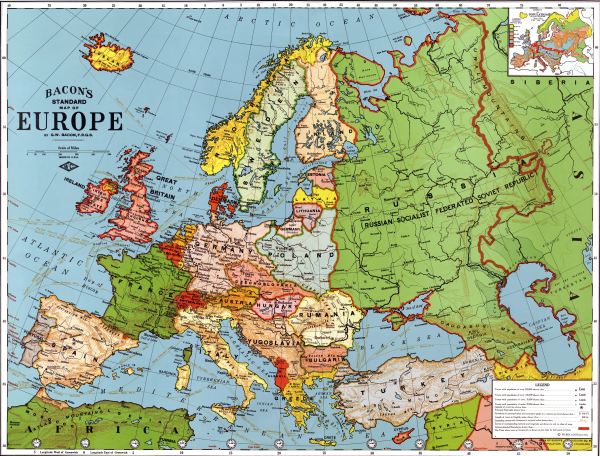
 Europe in 1923 [public domain]
Overview
NEW!
Course start date: Monday 26th January 2026
Course end date: Friday 3rd April 2026
Special Offer Price: £145 BOOK NOW
Tutor: Lynne Thompson
Course Code: HIST057
Level: Non-accredited, non-credit bearing
Assessments/Exams: None. Throughout the course you will be given ideas and questions to respond to in the online discussion area. Participation in online discussion is encouraged, but not compulsory.
Duration: 10 weeks
Estimated Student Study Time: 5 – 8 hours per week are recommended, but time spent is flexible and at your discretion.
Fee: £150.00
Pre-Requisites: No academic qualifications or other experience of studying history is required – only a strong enthusiasm for this subject.
Delivery: Online Distance Learning
Late Entrants: If this course is not full by the start date then late entrants will be accepted for up to two weeks after the start of the course. As a late entrant you can choose to catch up on the material you have missed or you can skip the missed weeks and concentrate on the material at the point where you join the course, but unfortunately we cannot offer fee reductions or course extensions for late entrants.
Recommended Reading**: Texts will be recommended within the course.
Required Reading**: There are no required texts for this course.
**Please note: All courses are subject to sufficient numbers of students registering before they are confirmed as running. Therefore, after booking your place you are advised not to purchase any texts until you have received confirmation that the course is running.
Summary
This is the first of two courses which covers events transpiring in the continent of Europe from historical, cultural and political perspectives, and during what has been called the ‘short’ twentieth century; that is, from 1914 to 1989. So we will cover two ‘hot’ wars and one ‘cold’ war, which ended with the fall of the Berlin Wall. Although it is indeed difficult to study this period without involving conflict and tragedy, we will also see how life was transformed for millions of Europeans as they encountered a truly modern age, and engaged with various interpretations of democratic governance.
In this first course we investigate why Europe went to war in 1914 and consider its long lasting impact, especially since it opened the door to new, revolutionary movements which took power; how did they cope with the crises which unfolded, and how far did authoritarian regimes rely on the willing participation of their peoples? By the end of the interwar period only Switzerland, France, the Low Countries, Scandinavia and the British Isles might be described as liberal democracies, but by 1945, after the Second World War, we will see how and why historians describe Europe as entering into a new ‘Golden Age’ of reconstruction and prosperity on both sides of the Iron Curtain. The first course ends with explanations of why Europe became divided physically, politically and ideologically by the Cold War, but which nevertheless maintained a kind of peace. As the second course will show, the economic certainties upon which Europeans depended were challenged by the mid 1970’s, and although the collapse of the Soviet Union was said to mark the ‘end’ of history, together with a new European dawn, it is argued that many of the problems lying dormant since 1918 began to reappear by the 1990’s.
Europe is seen as an ‘old’ continent, or part of the ‘Old World’, but by the end of these two courses it will be possible to understand why and how the European present emerged in less than a century, and how far it has been influenced by its past.
Syllabus Plan
The programme for the first course is as follows:
Introduction – Europe in 1914
The causes of the First World War: who was to blame?
Experience of the First World war in Europe 1914-1918
Versions of democracy 1918-1939: new states and old
Versions of democracy 1918-1939: the quest for popular support
The causes of the Second World War
War and the people; war against peoples
Who (or what) ‘won’ World War Two?
Welfare states and modernising societies
A divided continent: Europe in 1948
Learning Outcomes
This course will help students to acquire:
- Knowledge of aspects of European history in the 1914-1948 time period;
- An awareness of the underlying concepts and debates relating to this subject area;
- Experience of analysing primary source material